(24/7) support +977-9851232668, +977-9801068400, +977-1-4964222
Home » Search & Rescue
Our Service
Helicopter Search and Rescue (SAR) & Mountain Rescue in Nepal
When the Himalayas test your limits, we provide the lifeline.
In the thin air of the high Himalayas, the margin for error is zero. Alpine Rescue Services stands as the premier authority in helicopter search and rescue, delivering elite technical extractions across Nepal’s most formidable peaks. We provide helicopter rescue in Nepal, rapid mountain rescue operations, and emergency helicopter evacuation for trekkers and climbers across the Himalayas.
From the treacherous Khumbu Icefall to the remote reaches of the Annapurna Massif, our specialized helicopter SAR teams are rigged and ready 24/7. We combine world-class aviation with seasoned alpine experts to ensure that when the mountains become unpredictable, your safety remains guaranteed. Trust the gold standard in mountain rescue to bring you home.
Working in close collaboration with local communities, national parks, and law enforcement agencies, our SAR teams use satellite tracking, aerial reconnaissance, and expert ground units to locate missing individuals fast. Led by experienced Sherpas and high-altitude climbers with unmatched knowledge of Nepal’s terrain and culture, our search and rescue operations are built for speed, precision, and humanity, because in a mountain emergency, every minute matters.
What Is Helicopter Search and Rescue?
Helicopter search and rescue (SAR) is a specialized emergency operation that uses aircraft to locate, reach, and extract individuals who are lost, injured, or stranded in terrain that is inaccessible by road or on foot. Unlike conventional rescue methods, helicopter SAR combines aerial reconnaissance, satellite tracking, and rapid deployment to dramatically reduce response time, often making the difference between life and death in high-altitude emergencies.
In Nepal, helicopter search and rescue is not a luxury. It is a necessity. The country’s extreme topography, unpredictable weather patterns, and remote trekking routes make aerial rescue the only viable option in most mountain emergencies. Whether a trekker collapses on the Everest Base Camp trail, a climber goes missing above 6,000 meters, or an expedition team is caught in a sudden avalanche, a helicopter search and rescue team can reach the scene within hours, something no ground team can match.
At Alpine Rescue Service, our helicopter SAR operations are staffed by experienced Sherpas, high-altitude climbers, and certified medical personnel who understand Nepal’s terrain at the deepest level. We coordinate directly with local communities, national parks, and law enforcement agencies to ensure every mission is executed with precision, speed, and cultural awareness.
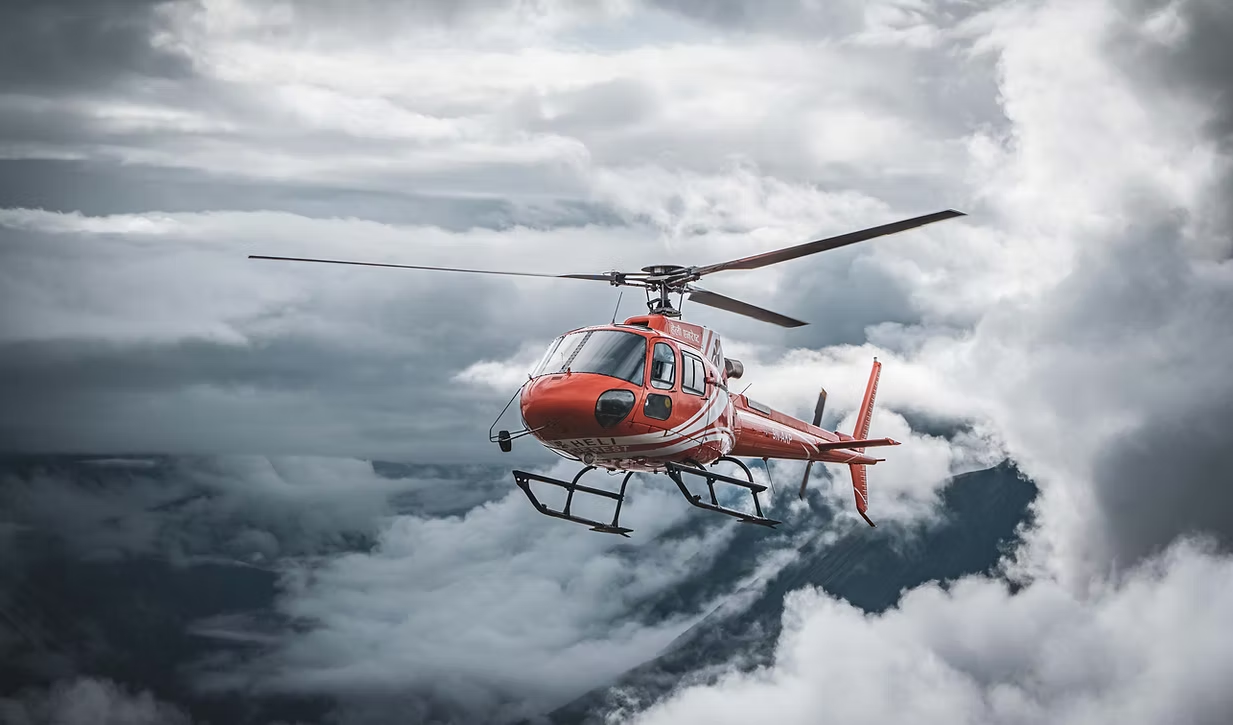
Rapid Response Helicopter Rescue & Mountain Rescue in Nepal
At elevations exceeding 6,000 meters, every second is a battle against hypoxia and volatile weather. Our high altitude mountain rescue operations are engineered for these exact Death Zone conditions. We provide specialized expedition rescue services that bridge the gap between a remote Himalayan peak and life-saving medical care.
The Logistics of Himalayan Rescue Operations
Success in the mountains is built on a foundation of seamless coordination. Alpine Rescue Services acts as the central nerve center for complex Himalayan rescue operations, maintaining a direct line of communication between:
- Expedition Teams: We work hand-in-hand with Base Camp managers and Sherpas, utilizing satellite tracking to pinpoint locations in real-time.
- Local Authorities: Our team maintains strong standing relationships with the Civil Aviation Authority of Nepal (CAAN) and the Himalayan Rescue Association (HRA) to ensure immediate flight clearances.
- Technical Rescuers: We deploy the world’s most capable high-altitude aircraft, the Airbus H125 (B3e), stripped for maximum lift and piloted by veterans with thousands of hours in high-density altitude environments.
Whether it is a pre-dawn medical extraction or a technical high-altitude rescue from an 8,000-meter peak, our rapid-response protocols ensure that expedition members are never truly alone. From initial distress signal to hospital handover, we manage the entire chain of survival.
Our Specialized Rescue Helicopter Fleet & Capabilities
In the vertical world of the Himalayas, the aircraft is more than a vehicle. It is a specialized medical tool. Every rescue helicopter in the Alpine Rescue network is selected for its high-density altitude performance. We primarily utilize the Airbus H125 (B3e), the undisputed workhorse of the sky, capable of landing on narrow ridges and performing hover-exits at elevations where most aircraft cannot even fly.
Our helicopter rescue capabilities are not just about the machine; they are about the configuration. Each bird is SAR-ready, meaning it is stripped of unnecessary weight to maximize lift and equipped with specialized medical kits, oxygen systems, and longline hardware for technical extractions.
Search and Rescue Helicopter Technology
Finding a single trekker in a vast, snow-covered landscape requires more than just a keen eye. Our search and rescue helicopter operations leverage a multi-layered tech stack to turn missing into found:
- Advanced Satellite Tracking: We sync directly with the victim’s GPS coordinates provided by satellite messengers to minimize search grid times.
- High-Gain Communication Systems: Our pilots use encrypted, high-frequency radios to maintain contact with Base Camp and ground spotters in “dead zones” where standard cellular signals fail.
- Thermal Imaging & FLIR (Forward-Looking Infrared): In low-visibility conditions or at night, we utilize thermal sensors to detect body heat signatures against the freezing Himalayan terrain.
- RECCO SAR Detectors: We carry specialized detectors that can locate RECCO reflectors integrated into modern trekking gear, even if the victim is buried under snow or debris.
Golden Hour Rescue: Why Every Minute Counts
In trauma and high-altitude medicine, we live by the Golden Hour, the critical window immediately following an injury or the onset of HAPE/HACE (High Altitude Pulmonary/Cerebral Edema). During this time, the probability of survival is at its highest if definitive medical care is provided.
Our 24/7 Readiness Protocol:
- Instant Dispatch: Our Alarm Center is manned 24/7 by coordinators who speak the language of both insurance and medicine.
- Pre-Flight Optimization: While flight permits are being cleared, our medical teams are already prepping the specific equipment needed for the reported condition.
- Rapid Transition: By the time we reach the Golden Hour, the patient is already being stabilized by an on-board flight medic, turning the rescue helicopter into a flying ICU.
Expert SAR Operations for Mt. Everest & Extreme Altitudes
Mount Everest is the ultimate proving ground for search and rescue. Operating in the Death Zone requires more than just a flight plan. It requires a level of precision where there is no room for a second guess. Alpine Rescue Services has established an unmatched track record for helicopter rescue on Mount Everest, specializing in the complex logistics of the Khumbu region.
The geography of Everest presents unique hurdles, from the shifting seracs of the Khumbu Icefall to the thin, turbulent air of the Western Cwm. Our teams are among the few in the world capable of executing a Mt Everest helicopter rescue at the absolute limit of aviation physics. Our Everest Base Camp rescue helicopter operations are among the fastest helicopter evacuation services in Nepal.
Navigating the World’s Highest Extraction Points
Our expertise is built on thousands of successful flight hours and a deep understanding of Everest’s micro-climates. We specialize in:
- Camp 2 (6,400m) Extractions: Serving as the highest frequent landing point on the mountain, our pilots execute precision touchdowns to evacuate climbers suffering from high-altitude cerebral edema (HACE) or exhaustion.
- Western Cwm Technical Flights: Navigating the “Valley of Silence,” where heat and thin air create volatile lift conditions, requiring elite-level power management.
- Base Camp Rapid Response: Maintaining a seasonal presence to ensure that Everest Base Camp rescue helicopter services are available within minutes of a distress call.
A Proven Track Record of Survival
Trust in high-altitude SAR is earned, not given. Over the years, our coordination team has managed hundreds of life-saving missions during the peak climbing seasons. We don’t just fly; we understand the mountain. By partnering with the world’s most experienced Himalayan pilots and elite ground teams, we ensure that even at 29,032 feet, you are never out of reach.
When the stakes are the highest on Earth, our track record is your greatest security.
Advanced Techniques: Longline Rescue & Technical Extractions
When the terrain is too steep for a landing skid or the snow is too unstable for a touchdown, the longline rescue becomes the umbilical cord of survival. Many search and rescue missions in the Himalayas take place on 60-degree slopes or inside deep crevasses where traditional landings are physically impossible.
The Anatomy of a Technical Extraction
A longline rescue (also known as a Human External Cargo or HEC operation) involves a specialized 30- to 50-meter synthetic rope attached to the belly of the helicopter. This allows our elite rescue technicians to be lowered directly to a stranded climber or casualty while the pilot maintains a precision hover above.
- Precision Hovering: Our pilots utilize the power reserves of the H125 to hold a steady position in high-wind, high-altitude environments.
- Static Line Extractions: Used for “short-haul” missions to move a patient from a dangerous face to a flat “staging area” for medical stabilization.
- Crevasse Extractions: Lowering a rescuer directly into glacial shears to retrieve fallen trekkers.
For a deeper look into the physics and safety protocols of this elite operation, visit our Longline Rescue Service Page.
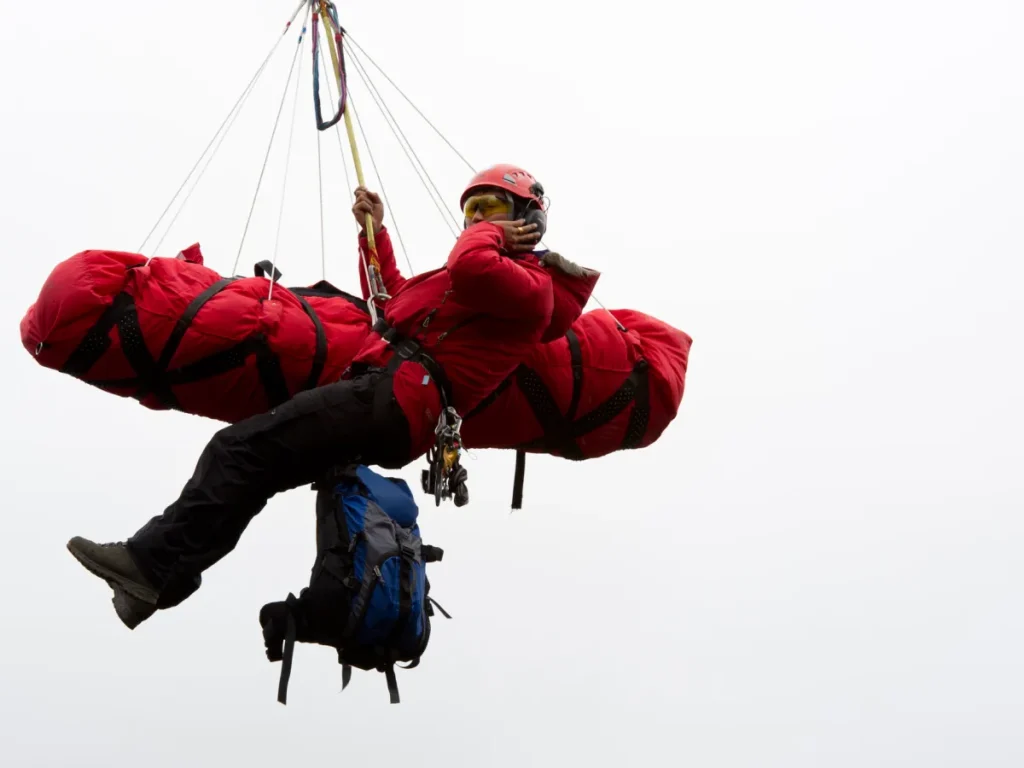
Transitioning from Search to Medical Care
Locating a missing person is only half the battle. Once a successful technical extraction is complete, our focus shifts immediately to clinical survival. Our emergency response services are designed to be a seamless Chain of Survival.
As soon as the casualty is secured inside the cabin, the rescue helicopter transforms into a mobile intensive care unit.
- Initial Stabilization: Our on-board medics are trained in wilderness medicine, specifically treating frostbite, high-altitude pulmonary edema (HAPE), and multi-trauma injuries.
- Emergency Medical Assistance: We provide continuous oxygen therapy and vitals monitoring during the flight to Kathmandu.
- Hospital Handover: Through our advanced medical evacuation services, we coordinate with the destination hospital to ensure a trauma team is waiting on the helipad the moment we touch down.
To learn more about what happens after the rescue, explore our Emergency Medical Evacuation protocols.
Whether it is trekking rescue in Nepal, Everest Base Camp helicopter evacuation, or high-altitude mountain rescue, Alpine Rescue Services provides rapid-response helicopter rescue across the Himalayas. Our experienced pilots, Sherpa rescuers, and medical teams ensure that climbers and trekkers in remote terrain can receive immediate assistance when emergencies arise.
Frequently Asked Questions About Helicopter Search and Rescue in Nepal
When should a helicopter rescue be requested in Nepal?
A helicopter rescue in Nepal is typically requested when trekkers or climbers face medical emergencies, altitude sickness, injuries, or become stranded in remote mountain terrain. In high-altitude regions like Everest Base Camp or the Annapurna Massif, helicopter evacuation is often the fastest and safest way to reach medical care.
How fast can a helicopter rescue reach trekkers in the Himalayas?
Response time depends on weather conditions, location, and flight clearances. In most cases, a helicopter rescue team can reach trekking regions within 30 minutes to a few hours after receiving an emergency call, especially in popular routes such as the Everest Base Camp trail.
What helicopters are used for high-altitude rescue in Nepal?
High-altitude rescues typically use specialized aircraft such as the Airbus H125, which is designed for extreme mountain environments. These helicopters can perform landings and hover rescues at very high elevations where many aircraft cannot operate.
Can helicopters rescue climbers on Mount Everest?
Yes. Helicopters can rescue climbers from certain locations on Mount Everest, particularly from areas such as Everest Base Camp and Camp 2. In extremely high-altitude zones, specialized longline rescue techniques may be required when landing is not possible.
What medical conditions often require helicopter evacuation in the Himalayas?
Common medical emergencies during trekking and climbing include altitude sickness such as HAPE (High Altitude Pulmonary Edema) and HACE (High Altitude Cerebral Edema), severe injuries, frostbite, and exhaustion. Rapid helicopter evacuation can help patients reach hospitals in Kathmandu for treatment.
How do trekkers request emergency rescue in Nepal?
Trekkers can request rescue through their guide, trekking agency, satellite messenger, or emergency rescue hotline. Once the distress signal is received, rescue coordinators arrange helicopter dispatch and coordinate with pilots, ground teams, and hospitals.
Ready When You Need Us

Search Experts
Skilled SAR teams navigate extreme weather, terrain, and altitude to locate missing trekkers efficiently.

Local Intelligence
Collaboration with Sherpas, locals, and agencies ensures fast, culturally aware search and rescue missions.

Tech-Assisted Rescue
Satellite tracking, aerial surveys, and ground units combine to pinpoint and reach stranded individuals quickly.
Support Without Delay
Immediate assistance when every second counts — our team is always ready to act swiftly and efficiently.
- Alpine House, Ekikaran Sadak, 16 Kha.2.37 Naya Bazar - 16, Kathmandu, Nepal
- P. O. Box: 21100
- 24/7 Hotline: +977-1-4964222, +977-9801068400, +977-9851232668
- Operation Landlines: +977-1-4962652, +977-1-4954711, +977-1-4960668
- Satellite: +88 21687729937
- E-mail: operation@alpine-rescue.com; info@alpine-rescue.com
In Collaboration With