(24/7) support +977-9851232668, +977-9801068400, +977-1-4964222
Home » Emergency Medical Evacuation
Our Services
Emergency Medical Evacuation & Air Ambulance Services in Nepal
Rapid Medevac Solutions for High-Altitude Critical Care
When every second counts in the high Himalayas, our emergency medical evacuation protocols ensure that patients receive specialized clinical care from the moment of pickup to the final hospital admission. As Nepal’s premier provider of air ambulance services, we specialize in bridging the gap between remote mountain peaks and advanced medical facilities, utilizing a fleet of medevac helicopters designed for high-altitude performance.
We provide more than just transport; we deliver a flying ICU environment. Our medical evacuation services are led by certified flight medics and high-altitude specialists who initiate life-saving stabilization during transit. Whether it is a cardiac emergency in the city or an altitude sickness evacuation from Everest Base Camp, our team is equipped to manage critical care in the most demanding environments on Earth.
Specialized Medevac Helicopter & Clinical Care
When a medical crisis occurs above 5,000 meters, a standard transport is not enough. We deploy a specialized medevac helicopter fleet from our strategic hubs in Kathmandu and Pokhara, engineered specifically for high-density altitude performance. Our mission is to extract patients from Nepal’s most demanding terrain while providing immediate clinical stabilization during the flight to advanced medical facilities.
Advanced Life Support (ALS) Infrastructure
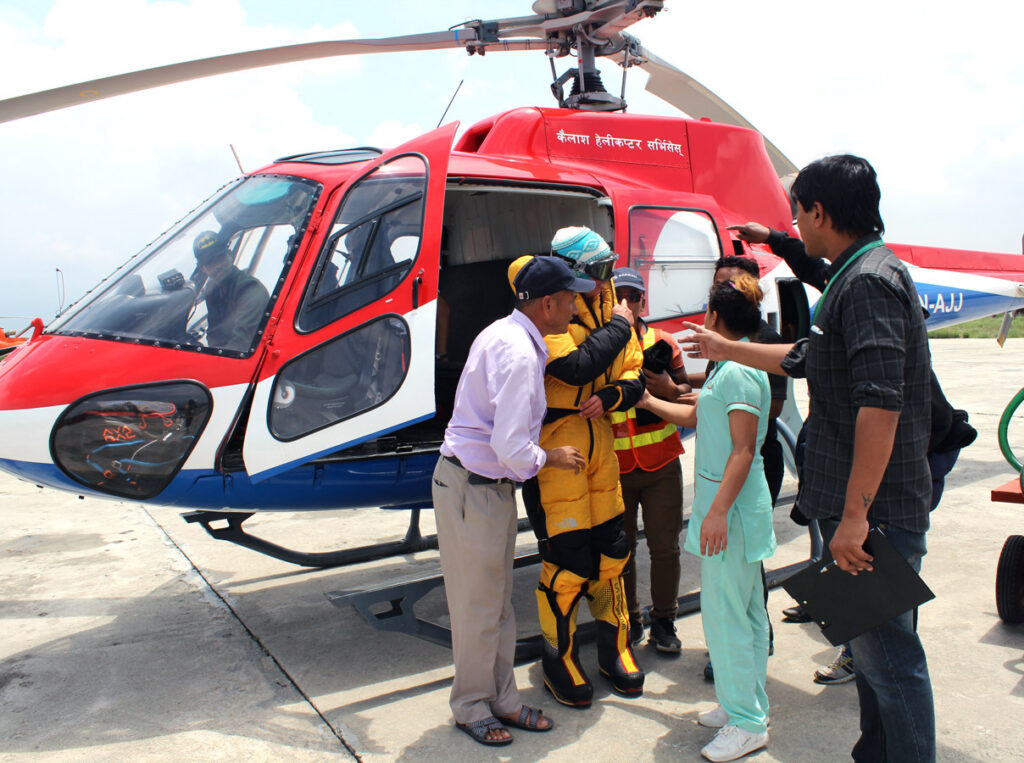
Unlike standard charter flights, our medevac helicopter fleet functions as a flying ICU. Each aircraft is outfitted with a comprehensive Advanced Life Support (ALS) infrastructure, including portable oxygen systems, cardiac heart monitors, and specialized trauma stabilization equipment. This ensures that critical care begins the moment the patient is secured, bridging the gap between the mountain and the hospital.
Specialized Altitude Sickness Evacuation (AMS, HAPE, HACE)
The Himalayas present unique physiological challenges that require more than just speed. We specialize in altitude sickness evacuation, providing rapid-response solutions for Acute Mountain Sickness (AMS), High Altitude Pulmonary Edema (HAPE), and High Altitude Cerebral Edema (HACE).
Our emergency medical evacuation protocols include the administration of pressurized oxygen and immediate rapid descent strategies. Every mission is supported by specialized medical instruments and, upon request, doctors trained in high-altitude trauma and wilderness medicine.
Nationwide Coverage: From Kanchenjunga to Api Himal
Our medical evacuation services span the entire length of the Himalayan range. We maintain 24/7 rapid-response readiness across three primary sectors to minimize flight times:
- Eastern Region: Everest Base Camp (EBC), the Khumbu Valley, Makalu, and Kanchenjunga.
- Central Region: Annapurna Circuit & Sanctuary, Manaslu Circuit, and the Langtang Valley.
- Western & Remote Regions: Dhaulagiri, Dolpo, Upper Mustang, and the far-west peaks of Api Himal and Saipal.
International Air Ambulance Standards in the Himalayas
When a severe medical emergency occurs in Nepal, local transport is only the first step. We bring international air ambulance protocols to the world’s most unforgiving terrain, ensuring that the clinical care a patient receives on the mountain meets global healthcare standards. As a trusted partner for international rescue operations, we manage the complex logistics required to move patients from high-altitude danger zones directly into advanced medical care.
Bed-to-Bed Medical Evacuation Services
For foreign nationals, expedition members, and corporate travelers, a rescue doesn’t end when the helicopter lands in Kathmandu. We coordinate seamless, end-to-end medical evacuation services, ensuring a smooth transition from a remote landing zone to specialized care. Our bed-to-bed transfer protocol includes:
Ground Ambulance Handoffs
Coordinating with specialized ground teams so an advanced life support ambulance is waiting on the tarmac before the helicopter arrives.
Hospital Admission Logistics
Pre-arranging trauma bays and surgical teams at Kathmandu’s top medical facilities, bypassing standard emergency room delays.
Global Repatriation Support
Working directly with international insurance providers and fixed-wing international air ambulance jets to seamlessly transfer stabilized patients back to their home countries.
AVERAGE LAUNCH TIME 15 MINS
Rapid Helicopter Evacuation from Remote Trekking Trails
In critical altitude emergencies or severe trauma, time is the single most critical variable.Our helicopter evacuation teams are strategically positioned and maintained on standby to reach Nepal’s most popular and remote regions, including the Annapurna Circuit, Everest Base Camp, and Langtang Valley.
By integrating directly with our 24/7 Alarm Centre, we bypass standard bureaucratic delays. Flight clearances, weather checks, and GPS pinpointing happen simultaneously with medical triage, ensuring our rotors are spinning while the patient is still within the critical Golden Hour of survivability.
📍 Everest Region
📍 Annapurna Circuit
📍 Langtang Valley
Protocol Efficiency
Optimizing the ‘Golden Hour’ of survivability through simultaneous dispatch.
100%
Ready Status
When is Medevac Required? Understanding the Process
High-altitude environments rapidly accelerate the deterioration of certain medical conditions. What might be a manageable issue at sea level can quickly escalate into a critical emergency at 5,000 meters. Our medical dispatchers utilize strict triage protocols to evaluate every SOS call and determine the necessity of an immediate airlift.
⚠️Clinical Indicators for Emergency Medical Evacuation
Expedition leaders, trekking guides, and individuals should immediately initiate an emergency medical evacuation if a patient exhibits any of the following clinical Red Flag indicators:
Severe Altitude Pathology (HAPE & HACE)
Extreme breathlessness at rest, coughing up pink or frothy sputum, severe ataxia (loss of coordination), or an altered mental state/confusion.
Traumatic Injuries
Major fractures, suspected spinal injuries, or severe head trauma sustained from falls or rockfall that make safe ground transport impossible.
Cardiovascular & Respiratory Emergencies
Chest pain, symptoms of a heart attack, or severe breathing difficulties exacerbated by the hypoxic (low-oxygen) mountain environment.
Acute Medical Illnesses
Severe gastrointestinal infections leading to critical dehydration, suspected appendicitis, or sudden unexplained unresponsiveness.
Seamless Integration with our 24/7 Alarm Centre
The moment a clinical indicator is met, the rescue process must be frictionless. Our flight medics and pilots work in lockstep with our 24/7 Emergency Response Alarm Centre. By the time our dispatchers confirm your exact GPS coordinates and initial medical status, hospital trauma bays in Kathmandu are already being prepped.
Protecting the Golden Hour of Survivability
Emergency Workflow
SOS Receipt → Triage → Flight Launch
✔ Hospital Pre-Notification Active
What is medical evacuation?
Medical evacuation (Medevac) is the emergency transport of an injured or ill person from the location of an incident to the nearest appropriate medical facility. It may be carried out by helicopter, air ambulance, or ground ambulance depending on the situation and terrain.
What services are offered by air ambulance providers in Nepal?
Air ambulance providers in Nepal offer helicopter evacuation, fixed-wing air ambulance transfers, medical escort services, and emergency coordination. They also arrange ground ambulance transfers and assist with insurance and hospital communication.
Is medical evacuation the same as repatriation?
No. Medical evacuation transports a patient to the nearest suitable hospital for urgent treatment. Repatriation refers to transporting the patient back to their home country after medical stabilization.
What is a medical evacuation plan?
A medical evacuation plan is a structured emergency response plan that outlines how a patient will be rescued and transported during a medical emergency. It includes rescue coordination, transport arrangements, and hospital referral procedures.
What is medical & non-medical evacuation in travel insurance?
Medical evacuation covers transport due to illness or injury requiring urgent treatment. Non-medical evacuation covers transport due to safety threats such as natural disasters, civil unrest, or security risks.
What is the best medical evacuation insurance?
The best medical evacuation insurance provides high coverage limits, helicopter rescue coverage, and 24/7 emergency assistance. It should also cover remote destinations and adventure activities like trekking.
Ready When You Need Us

Rapid Response
Deployed within minutes from Kathmandu or Pokhara to reach patients in remote, high-risk zones.

High-Altitude Rescue
Specialized evacuations from elevations above 5,000 meters, ensuring fast and safe patient extraction.
Critical Care Airlift
Equipped with life-support systems and trained medics for immediate in-flight emergency treatment and stabilization
Support Without Delay
Immediate assistance when every second counts — our team is always ready to act swiftly and efficiently.
- Alpine House, Ekikaran Sadak, 16 Kha.2.37 Naya Bazar - 16, Kathmandu, Nepal
- P. O. Box: 21100
- 24/7 Hotline: +977-1-4964222, +977-9801068400, +977-9851232668
- Operation Landlines: +977-1-4962652, +977-1-4954711, +977-1-4960668
- Satellite: +88 21687729937
- E-mail: operation@alpine-rescue.com; info@alpine-rescue.com
In Collaboration With