(24/7) support +977-9851232668, +977-9801068400, +977-1-4964222
Home » 24/7 Emergency Response Alarm Centre
Our Services
24/7 Emergency Response Services & Crisis Coordination
Nepal’s Lifeline in Crisis Moments
Operating in one of the world's most geographically complex nations, our Emergency Response Services serves as the vital communication bridge connecting Nepal's remote regions with fast-response teams and urban medical facilities. Strategically located in Kathmandu and staffed around the clock by trained dispatchers, our command center receives emergency calls from across Nepal's vast terrain, from teahouses in Solukhumbu's high valleys to mountain lodges along the Annapurna Circuit.
When a crisis occurs at altitude, we provide immediate emergency medical assistance, acting as the specialised "nerve center" that initiates life-saving protocols within minutes. Our facility is the crucial link between those in distress and the medical evacuation services required to navigate Nepal's challenging mountain environment.
Immediate Emergency Medical Assistance in the Himalayas
When a crisis occurs at altitude, the first few minutes determine the outcome. Our Emergency Response Services provide the specialized emergency medical assistance required to stabilize patients in “blackout zones” where traditional mobile networks fail. We act as the clinical bridge between a remote distress signal and the final hospital transfer, ensuring that life-saving protocols are initiated the moment a call is logged.
24/7 Medical Triage and Ground Communication
Our Alarm Centre is staffed by experienced dispatchers trained in high-altitude pathology. Upon receiving a SOS, we perform immediate medical triage to assess the severity of conditions like HAPE (High Altitude Pulmonary Edema) or traumatic injury. By maintaining constant ground communication with trekking guides and expedition leaders, we provide real-time instructions on stabilization, oxygen administration, and positioning while the search and rescue helicopter is en route.
Telemedicine Support for Remote Trekkers and Climbers
In 2026, connectivity is the ultimate survival tool. We leverage advanced telemedicine support to connect climbers in the high Himalayas directly with specialized doctors in Kathmandu. Through satellite-linked video and data feeds, our medical team can monitor vitals and advise on the administration of emergency medications. This proactive layer of emergency medical assistance ensures that even those at 6,000 meters have access to professional clinical oversight during the most critical phases of an evacuation.
Our Emergency Rescue Process: From SOS to Dispatch
The efficiency of an emergency rescue process is measured in minutes, not hours. At our Kathmandu-based Alarm Centre, we follow a rigorous, response protocol designed to eliminate delays. From the moment a distress signal is received, whether via satellite phone, InReach device, or local radio, our team initiates a synchronized workflow that balances medical urgency with flight logistics.
Situation and Urgency
The patient’s medical condition determines whether speed or stability is the priority. If a patient is unconscious, in respiratory distress, or showing signs of severe altitude illness, rapid air evacuation may be necessary. However, if the condition is stable such as a controlled fracture, moderate dehydration, or manageable altitude symptoms safe ground transfer may be medically appropriate. The objective is not speed alone; it is clinical suitability.
Geography and Accessibility
Nepal’s terrain is complex. Remote trails, narrow valleys, high-altitude landing zones, and sudden weather shifts can make helicopter operations unsafe or temporarily impossible. Cloud cover, wind conditions, and limited landing space must be assessed before any dispatch. In some cases, descending by foot, horse, or stretcher to a safer pickup point is the more responsible option.
Availability of Resources
We use whatever option is available and most suitable at that time. If there is a road, we may use a jeep. If the patient is on a narrow trail, Sherpas may carry them to the road. If there is a nearby airport, we may use a regular flight. Sometimes we use a helicopter first and then a commercial flight. We choose the method that safely brings the patient to the hospital in the easiest and safest way, not the one that looks impressive.
Safety First
The safety of the patient and the rescue team always come first. Every evacuation method is chosen to reduce risk as much as possible. Flying in high mountains can be risky, and moving at night on unstable trails can also be dangerous. We carefully balance urgency with safety. No rescue should put the patient or the crew at unnecessary risk.
The safety of the patient and the rescue team always come first. Every evacuation method is chosen to reduce risk as much as possible. Flying in high mountains can be risky, and moving at night on unstable trails can also be dangerous. We carefully balance urgency with safety. No rescue should put the patient or the crew at unnecessary risk.
The Technology Powering Our Command Center
Behind every successful rescue is a advanced digital backbone. Our command center is designed with triple-redundancy, ensuring that we remain the Eye in the Sky even when local infrastructure fails. We don’t just manage calls; we manage a high-tech ecosystem that tracks every variable of a mission in real-time.
Advanced Satellite Tracking
In the high Himalayas, "zero signal" is a reality for most travelers. For our center, it is where we do our best work. We utilize advanced satellite tracking platform to monitor trekking groups and flight crews with meter-level precision. By maintaining uninterrupted comms, we bridge the gap between remote "blackout zones" and urban medical specialists. This constant data flow allows our dispatchers to provide live weather updates and terrain analysis to pilots, turning a "blind flight" into a calculated, data-driven operation.
Direct Coordination with Specialized Evacuation Teams
Our technology serves a singular purpose: precision in execution. The Alarm Centre maintains a dedicated, encrypted uplink to our specialized evacuation teams on the ground and in the air. Before a rotor blade even spins, our tech stack has already transmitted GPS-precise landing zone coordinates, patient vitals, and altitude-specific flight paths to the crew. This seamless handoff is the foundation of our specialized medical evacuation services, ensuring that when the rescue team arrives, they are fully briefed and ready for immediate intervention.
Frequently Asked Questions about Our Emergency Response Services
How do I contact the Alarm Centre during a crisis?
Our emergency response services are accessible 24/7 via satellite phone (+88 21687729937) and local hotline (+977-9851232668). We recommend saving these numbers before starting your trek.
What is the emergency rescue process after I call?
Once an SOS is received, our team performs immediate medical triage, secures flight permits, and dispatches the nearest rescue assets. Our emergency rescue process is designed to minimize delays and initiate coordination within minutes.
Can you provide medical assistance if there is no phone signal?
Yes. We utilize advanced satellite tracking and uninterrupted comms through Iridium and Starlink. This allows us to provide emergency medical assistance and guidance to teams in remote blackout zones.
Do you coordinate with travel insurance?
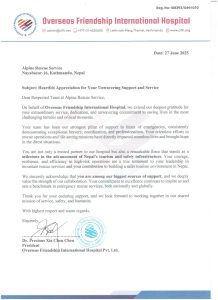
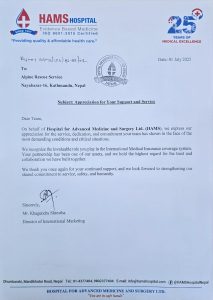
Absolutely. We act as the local liaison for international insurance and partnership agencies, providing the necessary documentation and real-time updates for high-altitude himalayan rescue operations.
Ready When You Need Us

Round-the-Clock Availability
Our alarm center operates 24/7, ensuring immediate response to any emergency, day or night.

Instant Communication
Highly trained responders are always on standby to answer calls and coordinate emergency services without delay.

Nationwide Coverage
Our emergency network extends across Nepal, providing timely support even in remote and high-altitude regions.
Support Without Delay
Immediate assistance when every second counts — our team is always ready to act swiftly and efficiently.
- Alpine House, Ekikaran Sadak, 16 Kha.2.37 Naya Bazar - 16, Kathmandu, Nepal
- P. O. Box: 21100
- 24/7 Hotline: +977-1-4964222, +977-9801068400, +977-9851232668
- Operation Landlines: +977-1-4962652, +977-1-4954711, +977-1-4960668
- Satellite: +88 21687729937
- E-mail: operation@alpine-rescue.com; info@alpine-rescue.com
In Collaboration With